


liberation movements:
embodied research methodologies and practice
provides opportunity for new and advanced students from any
discipline or major to experiment with short-term and group performance ethnography exercises that build individual and collective capacity for using the body and rebel creativity as core approaches to independent ethnographic inquiry. through studio movement practice and the centering of bodily ways of knowing, participants build heightened exposure and awareness of when and how such methods and inquiry might be useful to community understanding, wellness and justice.

When I signed up for my last honors class, I wanted to be truly challenged. Liberation Movements not only challenged me, but changed me. It drew out certain tendencies I already had, and asked me to exercise them in new ways (for example, I was already likely to wax poetic in the right circumstances, but if you’ve been reading my portfolio, you’ve found out that tendency is stronger than ever). If, throughout my time in college, I’d been pulling together stories, ideas and understandings about the world in my head, this class, and Dr. Chapman, asked me to unspool all of it, set it in front of me, and make something out of it.
During every class period, we were practicing a ritual, coming together as a class community in a sacred space. We were asked to lean into the circle — the class community we were forming — by striving to be vulnerable, honest, and open to possibility. We were asked to hold each other, in pain and joy and every emotion on the spectrum. In discussions of identity, social change, performance, Orisha, afro-futurism, Blackness, critical race theory, and ethnographic practice, having a strong and reliable circle was the only way the class could reach its full potential. Our practice was literally getting up and moving together: learning Orisha dance from co-teacher Ife Ina, doing movement experiments (scores) from Anna Halprin’s book Making Dances that Matter, and coming up with our own scores and experiments to move together. All of this, we did as an exploration of what ethical and just futures might look like, what healing could be done, what discoveries could be made. A lot of people might take one look at this class and think, this is the most hippy-dippy sh*t I’ve ever seen, how can you take this seriously? (sorry for the profanity, but this is the honest truth). And believe me, it was a choice you had to make, to go all in without really understanding what was going on. But opening myself up to the possibility of it all was a really powerful thing.
I’ve never been asked to give so much to a class, and I’ve never felt so motivated to give it. But for all my motivation, I struggled — hard. My whole college experience, my whole schooling experience, in fact, had consisted of cognitive understanding and communication up until this point. Now I was being asked to take all of that cognitive understanding and put it into movement and art. The art part I had practiced at, and understood. The movement part I had no prior experience to draw from. I quite literally had to learn a whole new language/vocabulary just to understand what was being asked of me. I was asked to think and process in a wholly different way, be vulnerable, focus on urgent life-and-death human experiences, and to do it all on zoom (my worst nightmare) for the first month, without having any in-person connection beforehand. I felt like it was freshman year again, and I was an 18 year old who was too paralyzed with sudden social anxieties to speak up in class. And at the same time, I felt so incredibly shallow and privileged for allowing things like that to bog me down and hold me back from engaging in conversations about LIFE OR DEATH issues. A lot of what I took away from this class was related to course content: what will centering blackness and pushing for our collective liberation look like in my future? What tools do I now have to this end? Thick solidarity is a muscle — how do I make mine stronger, what does it look like to exercise it? But another substantial portion was reflecting on this recurring internal struggle, and at the core of it, how do I actually show up with honesty and authenticity?
I didn’t nearly answer all of my/our questions over the course of the 10 weeks, and if I had, then I/we would’ve been asking the wrong ones. Since freshman year, when I took Climate Extremes and had a bit of a breakdown, I’d been avoiding most existential exploration. I think this course was an important part of unblocking that pathway. Living is HARD. But also, many truths, painful and wonderful, can exist at the same time, and we hold multitudes. Call me hippy-dippy, but also, if we’re going to be alive — wouldn’t you rather live in awe of the interconnectedness of the universe?
"a lot of people might take one look at this class and think, this is the most hippy-dippy sh*t I’ve ever seen, how can you take this seriously?...but opening myself up to the possibility of it all was a really powerful thing"
 self portrait 1 |
|---|
 physical / emotional / mental / spiritual responses to global history of struggle |
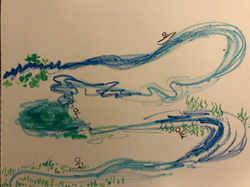 imagining just futures |
 surveillance as an archive & repertoire |
 global history of struggle timeline |
 on the side of love |
 self portrait 2 |